
Industrial Rubber Lining · Porter, TX · Texas & Gulf Coast · Nationwide Mobilization
Industrial Rubber Lining Services
Abrasion- and corrosion-resistant rubber linings for tanks, vessels, and piping in severe service — custom-matched compounds, installed on-site or in-shop, and vulcanized for a bond that lasts.
Request a Quote (281) 900-5779What Is Industrial Rubber Lining?
Elastomeric Protection for Severe-Service Equipment
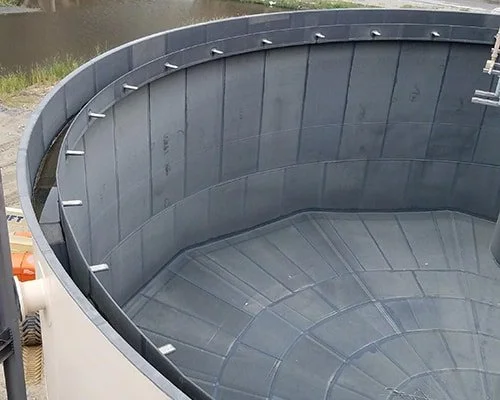
Industrial rubber lining is the installation of bonded rubber sheets inside tanks, vessels, and piping to protect against chemical corrosion, abrasion, and leakage — the go-to defense where aggressive chemicals or abrasive slurries would destroy conventional coatings.
Where acids attack steel and slurries grind through paint, rubber linings absorb the punishment. Allied Industrial Services installs rubber lining systems in chemical tanks, slurry tanks, scrubbers, process vessels, and pipelines — selecting the rubber type (natural rubber, neoprene, butyl, and other compounds) to match your chemical exposure, temperature, and service conditions.
Linings can be installed on-site for large, stationary tanks that can't leave service locations, or in-shop under controlled conditions for smaller tanks and vessels. Whether it's a first-time lining, a repair, or a complete reline of worn rubber, Allied delivers the work with the same project-management discipline behind all of our coating and lining services.
Our Capabilities
Rubber Lining Services
New Lining Installation
Complete rubber lining systems for new or newly repurposed tanks, vessels, and piping — from surface prep through vulcanization and final inspection.
Relining & Repairs
Removal of worn or damaged rubber and installation of new lining — full relines that extend tank life, or targeted repairs when damage is localized.
On-Site & In-Shop Lining
Large, stationary tanks are lined in place without leaving your facility; smaller tanks and vessels can be lined in-shop under controlled conditions for optimal results.
Custom Compounds
Tailored rubber formulations for demanding conditions — high temperatures, highly aggressive chemicals, or a change in tank service that calls for a different material.
Complex Geometries & Fittings
Lining adjusted for tanks with complex shapes, fittings, and nozzles — so protection is complete, not just where the flat sheets fit easily.
Inspection & Thickness Testing
Regular inspections and thickness testing detect wear, cracks, or detachment early — before a lining failure becomes a corrosion or leak problem.
How It Works
Our Rubber Lining Process
Assess & Select
We evaluate your chemical exposure, temperature, and service conditions to select the right rubber compound.
Prepare
Cleaning, sandblasting, or grinding readies the substrate — adhesion depends on surface preparation done right.
Apply
Rubber sheets are fitted and installed, with special attention to seams, fittings, and complex geometry.
Vulcanize
The lining is cured to bond it securely to the tank surface for long-term durability in service.
Inspect & Test
Final inspection and thickness verification confirm complete, uniform protection before return to service.
Where We Work
Rubber Lining Across Industrial Sectors
From chemical processing tanks to slurry lines in mining and scrubbers in power generation, Allied installs rubber linings wherever aggressive chemicals and abrasive materials meet critical equipment.
Common Questions
Rubber Lining FAQs
When is rubber lining better than a coating or epoxy lining?
Rubber linings excel where equipment faces both chemical attack and mechanical abuse — abrasive slurries, aggressive acids, high-wear flow. A thick, elastic rubber sheet absorbs impact and abrasion that would wear through thin-film coatings, while resisting chemicals that attack steel. For milder exposures, an epoxy or specialty coating may be the more economical choice — Allied installs both, so our recommendation is based on your service conditions, not on the one system we happen to sell.
Which rubber material is right for my tank?
It depends on what the tank holds and how it operates. Natural rubber offers excellent abrasion resistance for slurries; neoprene handles oils and moderate chemicals; butyl provides strong chemical and gas-permeation resistance. For high temperatures or highly aggressive chemistries, custom compounds can be formulated. Allied matches the material to your specific exposure before any work is scoped.
Can you line our tank on-site, or does it have to be shipped?
Both options are available. Large, stationary tanks are lined on-site without leaving their service locations. Smaller tanks and vessels can be brought in-shop, where lining is applied under controlled conditions. We'll recommend the approach that best fits your equipment, schedule, and quality requirements.
Our lining is worn — do we need a full reline?
Not always. Inspection and thickness testing determine whether targeted repairs will restore protection or whether wear is extensive enough to justify a complete reline. If your tank's service has changed — different chemicals, higher temperatures — we may also recommend a different lining material as part of the reline.
How long does a rubber lining last?
Service life depends on the material, the exposure, and the operating conditions — well-specified linings in appropriate service last many years. Regular inspections and thickness testing are the key to maximizing that life, catching wear or detachment early so small repairs prevent big failures.
Porter, TX · Houston · Texas & Gulf Coast · Nationwide Mobilization
Line It Once. Line It Right.
Tell us what your tank holds and how it runs — we'll recommend the right rubber system and deliver it on-site or in-shop, safely and to spec.
Request a QuoteOr call (281) 900-5779
